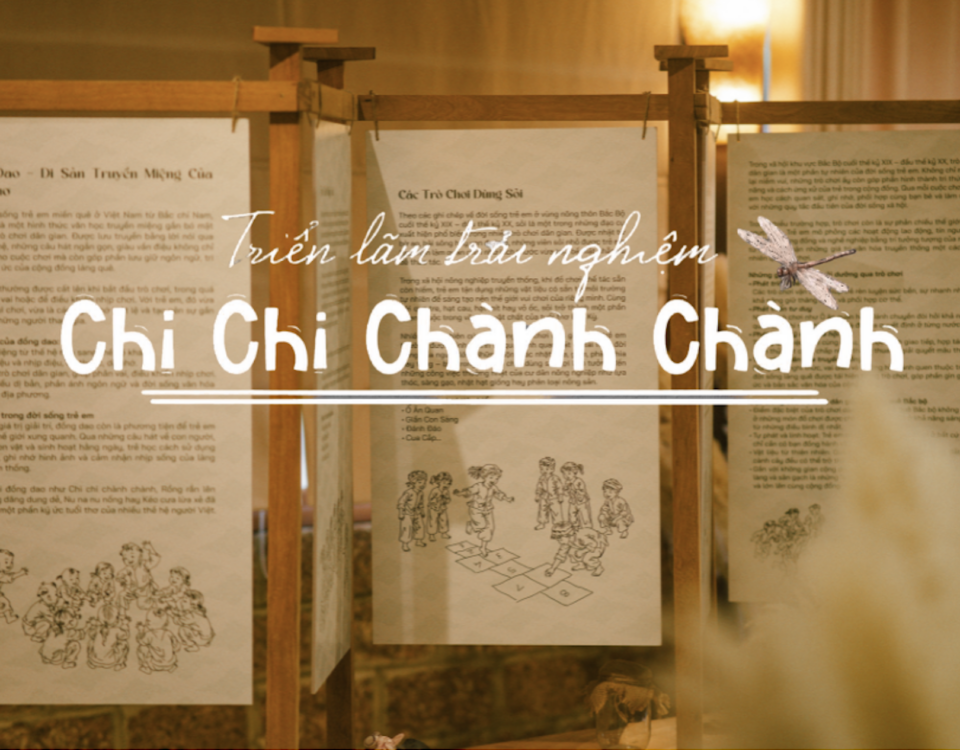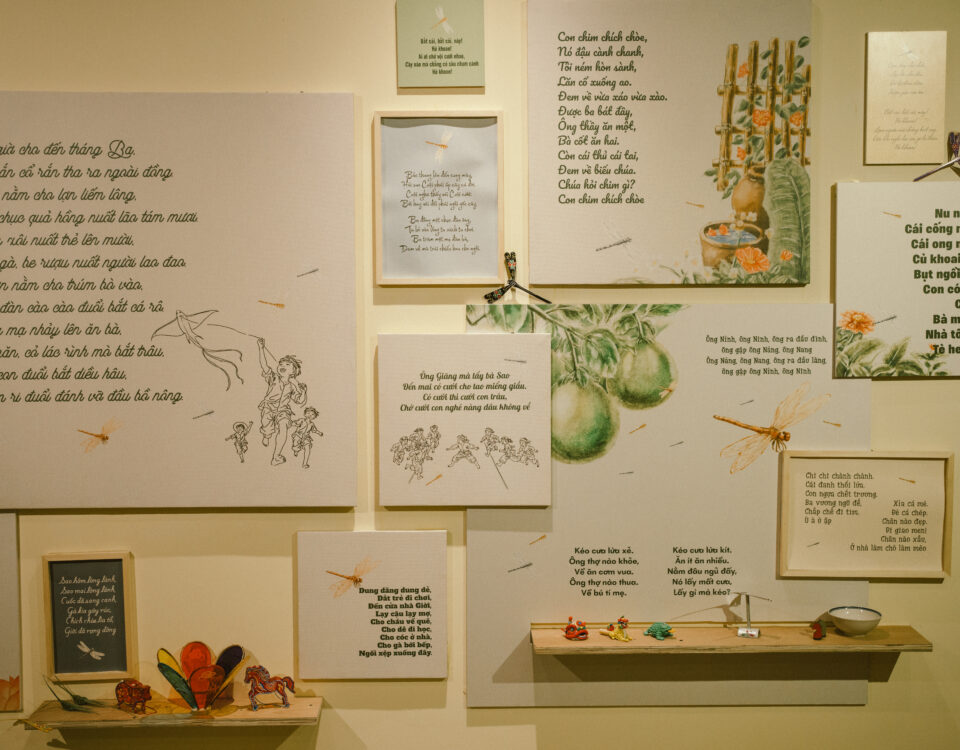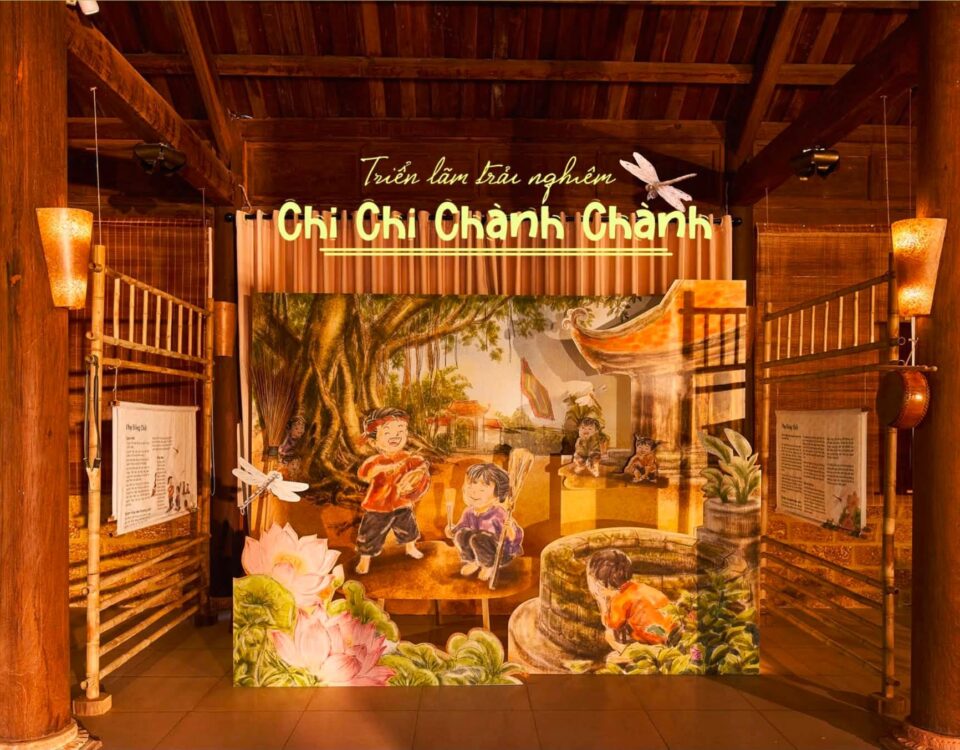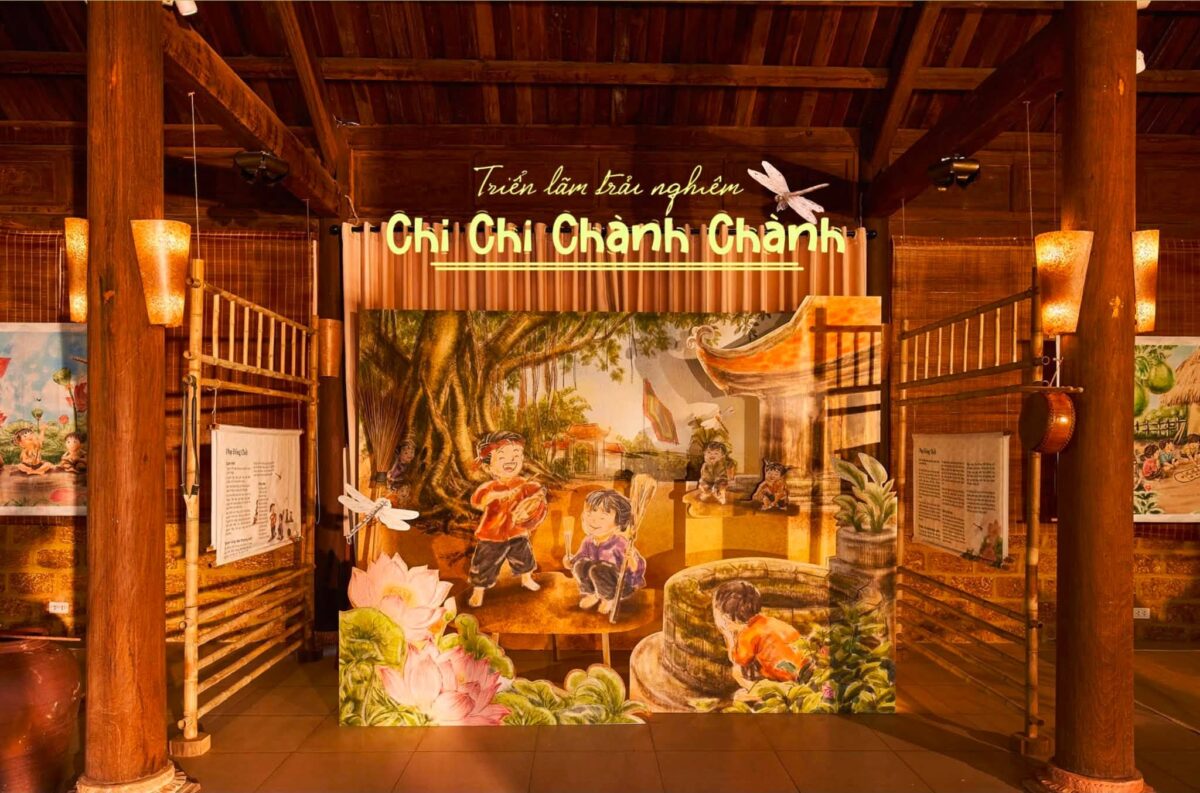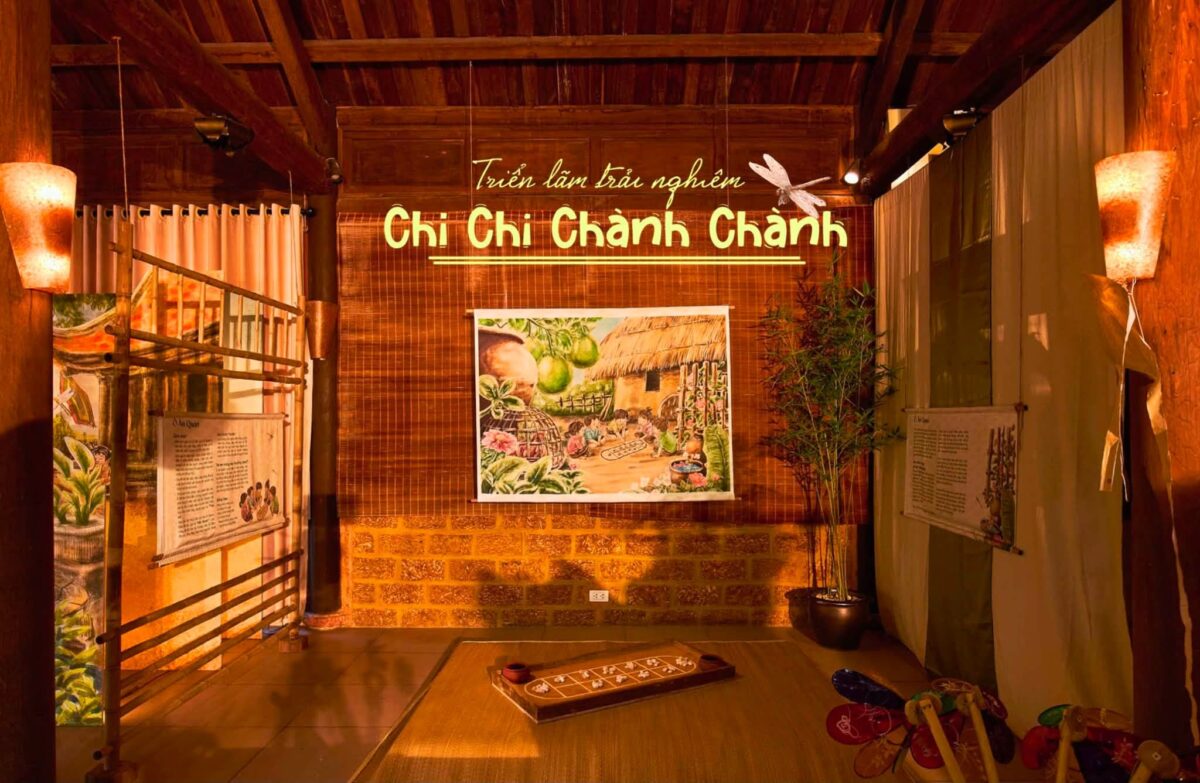
The Exhibition Chi Chi Chành Chành
Vietnamese Mancala
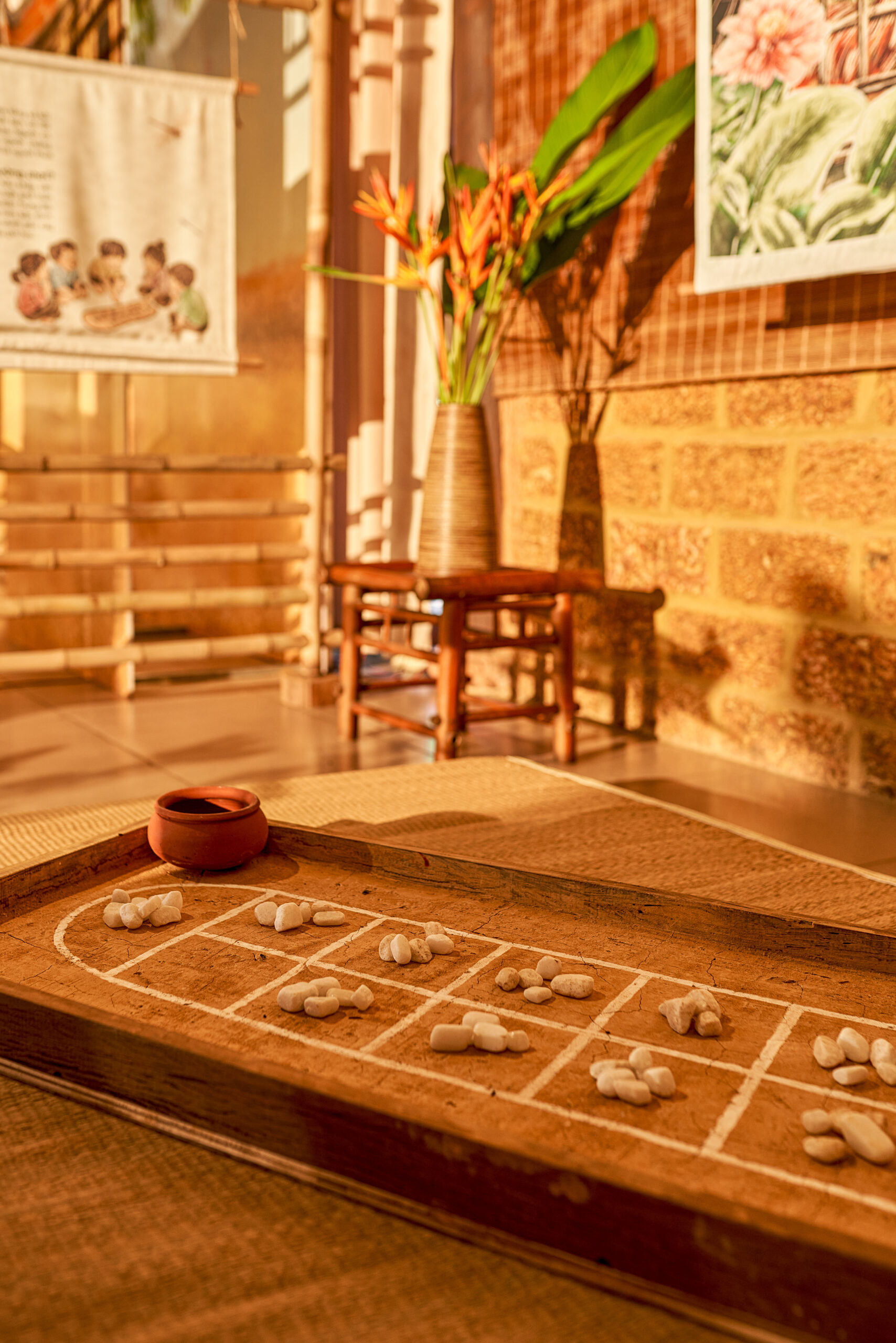
One of the oldest and most popular folk games in Vietnam. With just a few pebbles, betel nuts, or jackfruit seeds and a set of squares drawn on the ground, children could play with fascination for hours. Beyond simple amusement, the game fosters mathematical calculation, strategic thinking, and patience.
A Reflection Of An Agrarian Society
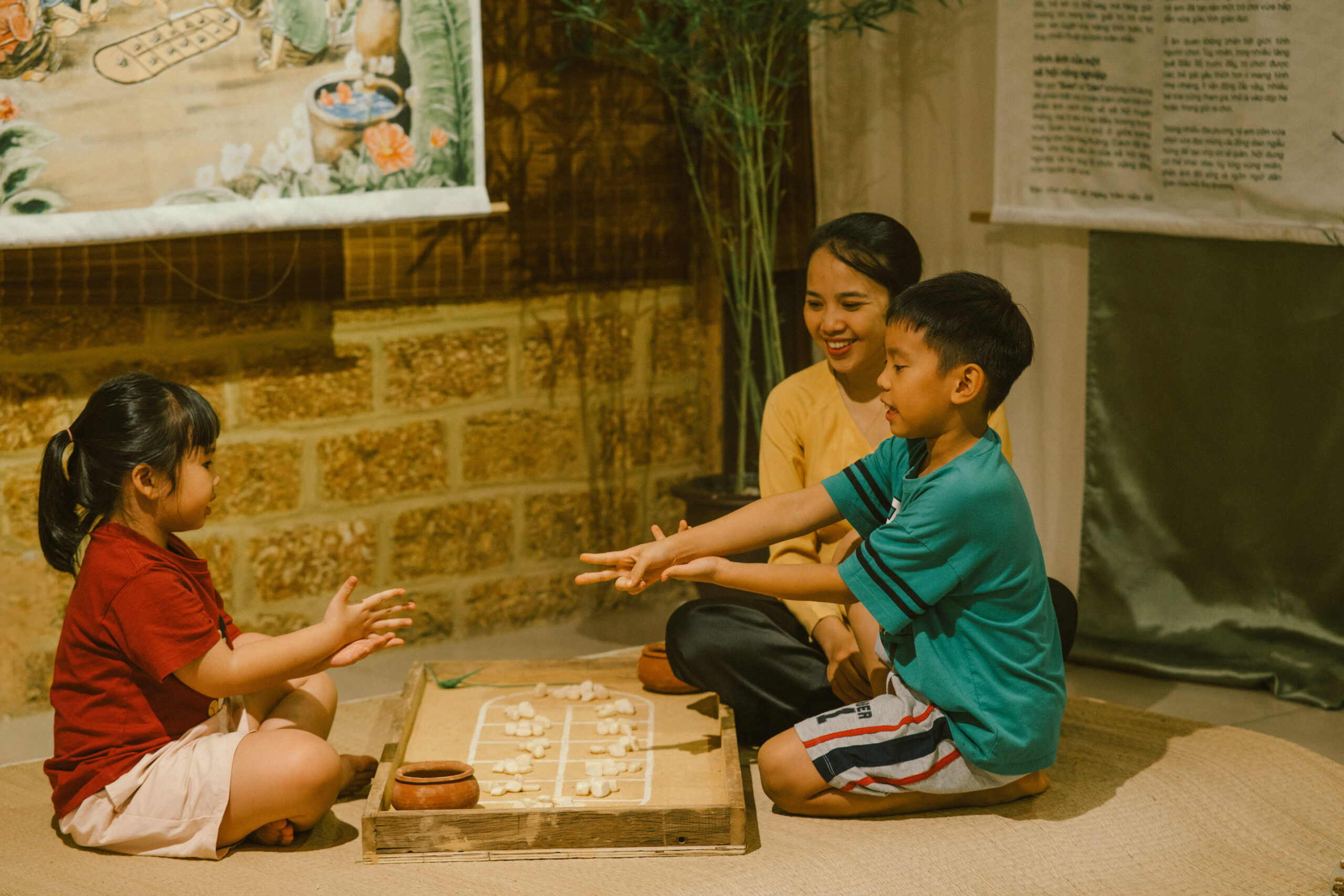
The terms “Quan” (Mandarin) and “Dân” (Peasant) serve not only to distinguish the spaces on the game board, but also reflect the social structure of traditional Vietnamese society. The two large semi-circular boxes at either end represent the Mandarins, while the ten smaller squares in between represent the peasant or ricefields. This naming convention carries the clear mark of an agrarian society and the communal organization of ancient Vietnam.
The game board was simply drawn on the dirt ground using a bamboo stick or a piece of brick. The game props are often pebbles, pomelo seeds, tamarind seeds, or seashells gathered from around the village. From these humble materials, children create a game that is both engaging and deeply educational.
How to Play
• Board Setup: The game board consists of ten peasant squares and two semi-circular boxes (Mandarin squares) at either end. At the start, each peasant square holds 5 pebbles, and each Mandarin square holds 10 pebbles.
• Sowing Pebbles: Players take turns picking up all pebbles from any non-empty peasant square on their side of the board and sows them one by one into adjacent squares in either a clockwise or counter-clockwise direction.
• Capturing: After sowing the last pebble, if the next square is empty and followed immediately by a square containing pebbles, the player captures all pebbles in that second square.
• “Releasing Fish”: If all peasant squares on a player’s side are empty when their turn comes, they must use five of the pebbles they have captured to refill before taking a move. This rule is traditionally known as “Releasing Fish”.
• “Fall of the Mandarins”: The game ends when both mandarin squares are empty, a condition known as “Fall of the Mandarins”. Any pebbles remaining in the peasant spaces are then divided equally between the two players. This final distribution is called “Scattering of Peasants”.
• Scoring & Victory: Both players count their total collected pebbles. A draw occurs if each player has exactly 35 pebbles (representing half the board’s total 70 points). The player with more than 35 pebbles wins the game.
Where Is This Game Played?
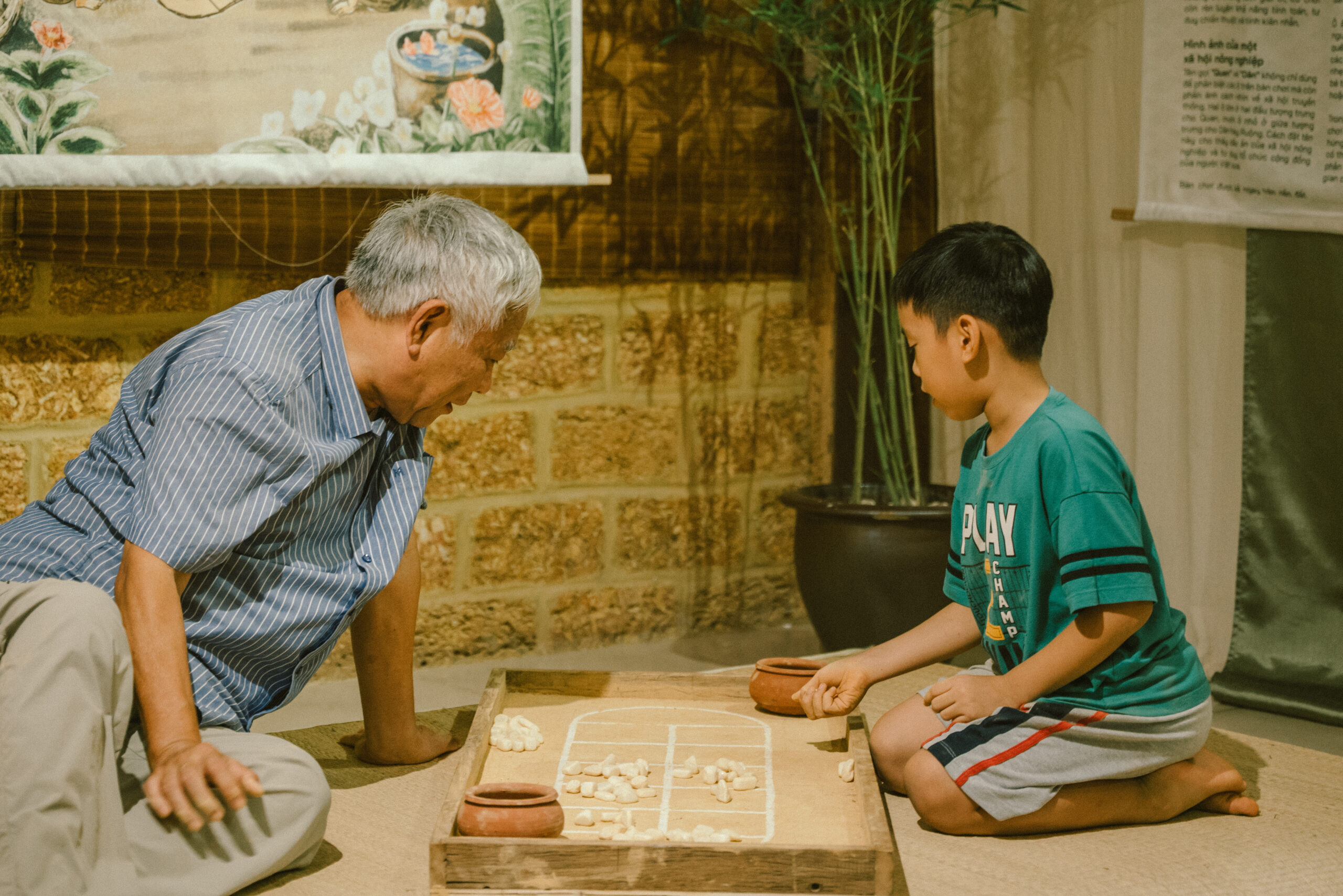
Vietnamese Mancala was played throughout many rural regions of Vietnam, particularly in the Red River Delta and the North Central Coast. Children often gathered to play in the courtyard of the village communal house, on brick-paved yards, on house verandas, or beneath the shade of village trees in the late afternoon after school.
Vietnamese Mancala was played by both boys and girls. However, in many Northern villages of the past, it was particularly favored by young girls for its gentle, low-impact nature. Even so, many boys also enjoyed the game, particularly during the summer holidays or school recess.
Rows of betel and areca,
Belong to the village girls.
Rows of cakes and fruits,
Belong to the old women.
Rows of incense and flowers,
Are offered to the Buddha.
In many regions, children also chant improvised folk rhymes as they distribute the playing pieces, helping to maintain the rhythm of the game. These verses exist in many local variations, reflecting the language, everyday life, and folk traditions of different communities.